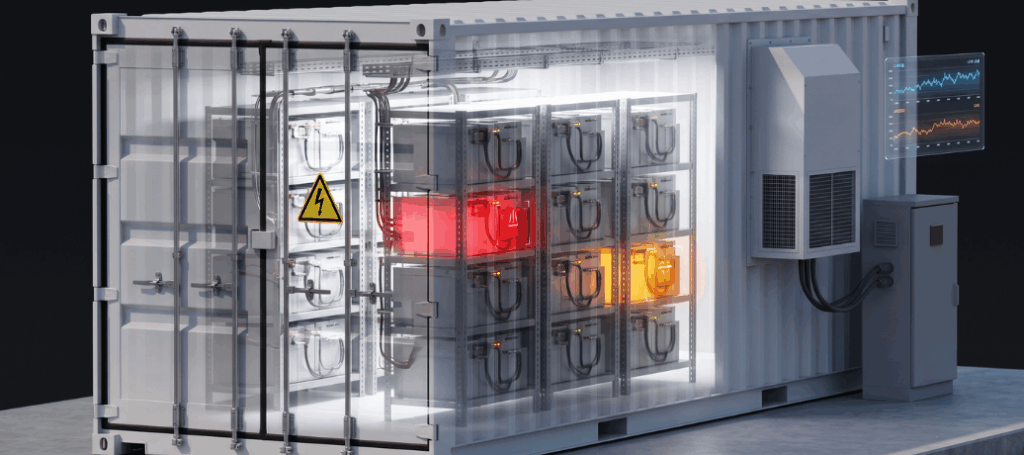
Continuous analysis of operating battery data reveals safety, performance and aging issues at module level, often long before a module needs to be replaced.
August 4, 2026 //
Blog // EN
BESS Fire Prevention Starts Before the Alarm
Following a recent battery energy storage system (BESS) fire in Bautzen, Germany, the discussion quickly turned to a familiar question: what additional safety measures are needed? In our conversations with BESS operators and project owners, the first response is often to install more sensors and detection and suppression hardware. These measures matter, but they are only one part of BESS fire prevention.
The cause in Bautzen is still under investigation, and this is not about assigning blame; a fire can start anywhere, from the inverter to the surrounding electrics. The question here is more general, and it matters most when a fault does originate in the battery itself.
In a guest opinion piece for pv magazine, our co-founder and managing director, Claudius Jehle, argues that an important safety measure is already available: the battery’s operating data. When used effectively, this data transforms fire prevention from a reactive process into an early-warning system.
The warning signs are already evident in the data.
Battery systems continuously generate thousands of voltage, current and temperature signals. Looking at individual thresholds alone can miss gradual changes. Comparing cells and modules, as well as analyzing historical behavior and the relationships between parameters, can reveal developing anomalies much earlier.
In one 80 MWh BESS in North America, a single module showed a growing thermal deviation from its identical neighbors over several weeks, while its absolute temperature stayed within limits. Neither the battery management system (BMS) nor the Supervisory Control and Data Acquisition (SCADA) system reported a fault. Continuous battery diagnostics made the developing imbalance visible days before it could have become critical.
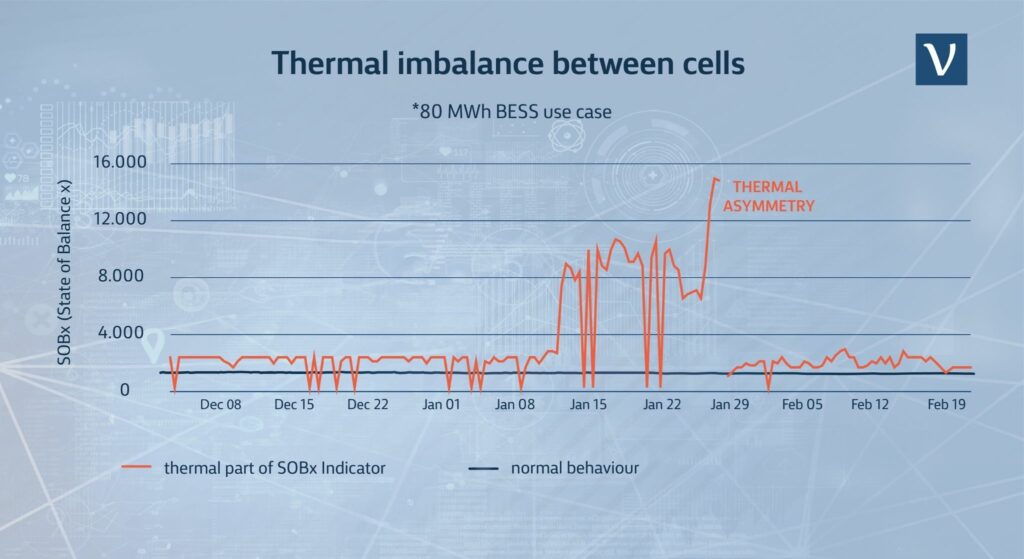
Why lead time is the real measure of BESS fire prevention
This is where the success of BESS fire prevention is determined. A ceiling sensor only confirms an event that is already underway. Reading the operating data reveals the underlying trend while there is still time to act. The point is not to replace fire protection hardware. Rather, the goal is to complement it with earlier insight and actionable recommendations. This gives operators more time to investigate, adjust operations, or replace affected components before a fault becomes critical. Effective BESS fire prevention combines robust on-site protection and continuous diagnostics that detect warning signs early.
Read Claudius Jehle’s full opinion piece in German on pv magazine: https://www.pv-magazine.de/2026/08/04/brandpraevention-bei-grossspeichern-vorlaufzeit-statt-aktionismus/
An English editorial summary is available on ESS News: https://www.ess-news.com/2026/08/05/battery-diagnostics-expert-urges-earlier-fire-detection-for-grid-scale-bess/