
Independent data verification to identify hidden capacity gaps in utility-scale BESS assets
April 15, 2026 //
News // EN
Utility-scale BESS monitoring: Addressing 11% Capacity Loss
Undetected cell imbalance recently revealed a weekly revenue risk of up to €110,000. Consequently, for effective utility-scale BESS monitoring, operators must recognize a critical gap. While local battery management systems (BMS) report full availability, physical constraints can render 11% of capacity unmarketable.
Discrepancies between BMS data and actual physical energy availability compromise the bankability of large-scale storage assets. Field data from a 350 MWh project in Europe confirms that cell imbalance can render significant portions of the system inaccessible, even when software reporting suggests the asset is fully operational.
Physical Constraints in Utility-Scale BESS Monitoring
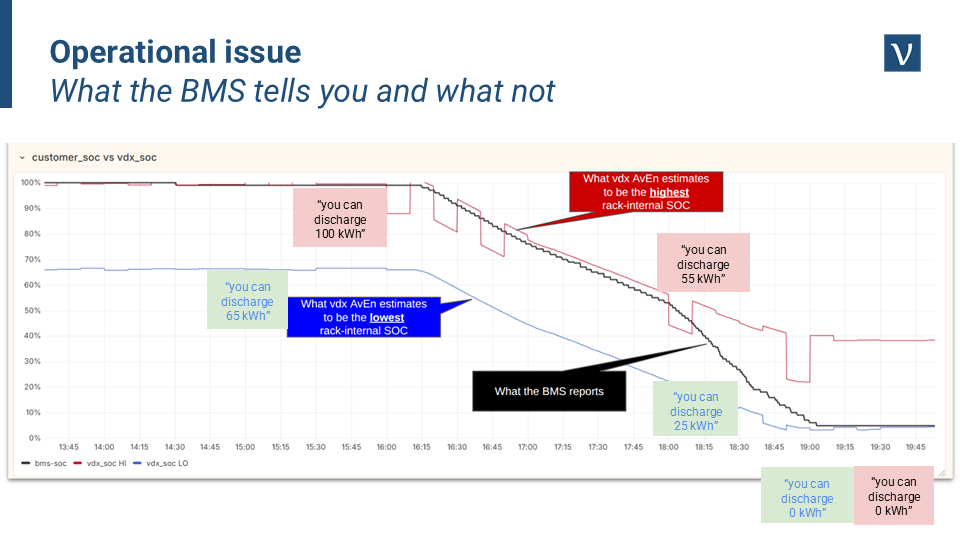
In series-connected systems, the weakest cell determines the operational limits of the entire rack. Specifically, when the most charged cell reaches 100% state of charge (SoC), charging stops. Conversely, the least charged cell triggers a discharge stop at 0%.
In this case study, a 25% charge spread resulted in a daily energy gap of 15 to 40 MWh. Consequently, this energy remains physically present but unmarketable.
Systemic Failure in LFP SoC Estimation
The flat voltage curve of lithium iron phosphate (LFP) chemistry makes precise state of charge (SoC) determination difficult. Furthermore, independent diagnostic algorithms identified errors of up to 50% in the state of charge (SoC) estimates provided by the rack-level battery management system (BMS). This “ghost capacity” results in significant financial exposure.
This “ghost capacity” results in significant financial exposure.
Balancing Costs: Weekly risks ranging from €25,000 to €110,000 in the German energy market.
Operational risk: Inability to fulfill delivery obligations due to overestimated physical reserves.
Pragmatic mitigation: Independent validation
Effective rebalancing requires the precise identification of drift velocity and synchronization points. Standard BMS logic often lacks the necessary granularity for these interventions. Utility-scale BESS monitoring must pivot toward independent State of Health (SOH) transparency and Available Energy (AvEn) validation to align trading strategies with physical asset reality.
Source: This analysis is based on technical case studies presented at the Battery Business & Development Forum and first reported by ESS News/PV Magazine.
Learn more about our battery analytics solution for grid-scale battery energy storage systems.