
From Installed Capacity to True Dispatchable Energy
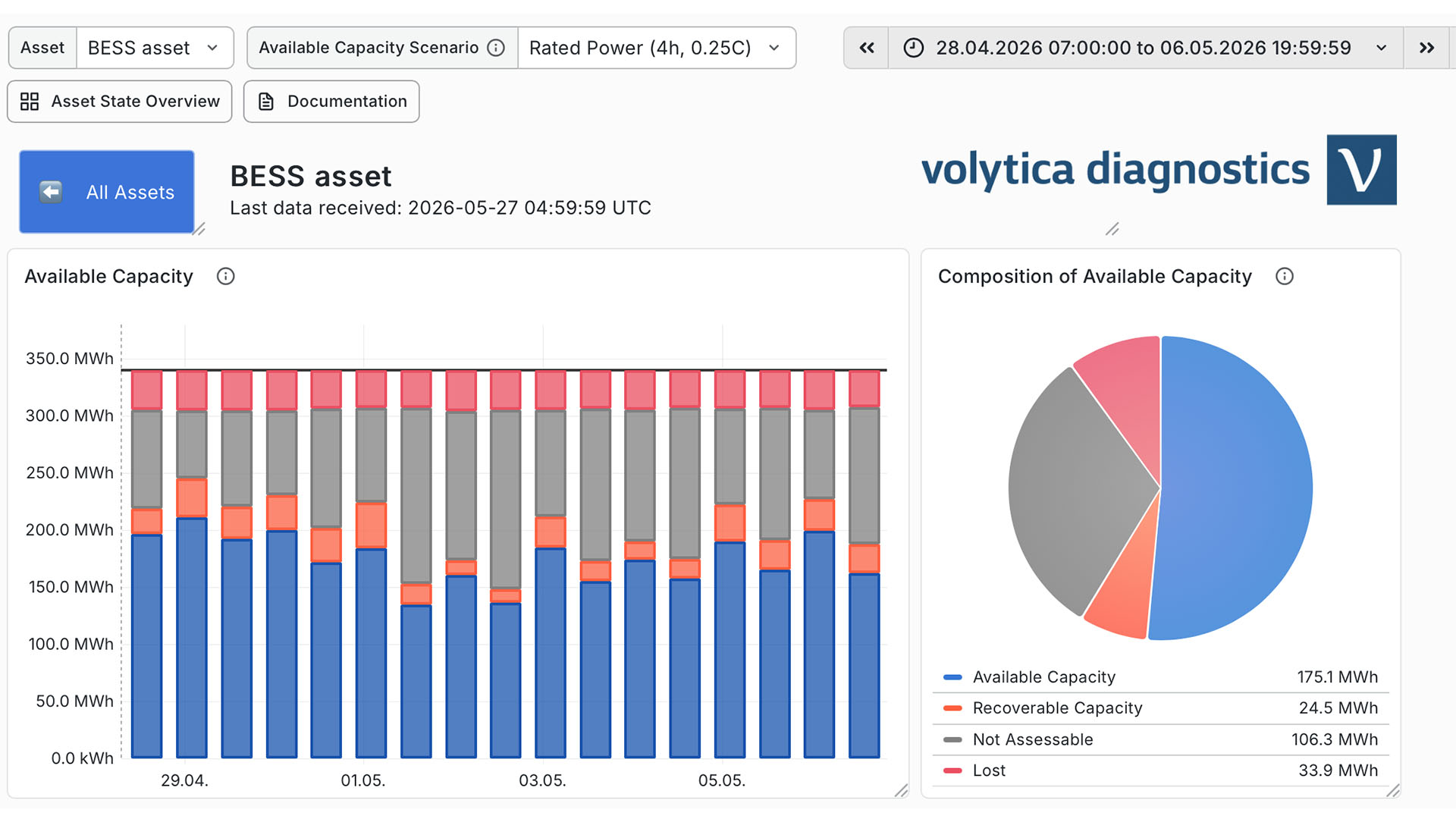
Cell imbalances, BMS (Battery Management System) estimation errors, and offline racks silently reduce the energy available for dispatch, often without the operator knowing. vdx AvEn focuses on capacity-relevant KPIs, using volytica's cloud-based analytics to determine the true dispatchable and recoverable energy of your system, from site level to the individual rack or module level.
Additionally, it provides deep insights into the capacity that might be trapped due to the mentioned effects and can be recovered. The aim is to regain as much capacity as possible.
The result: a bankable signal for trading decisions, non-delivery risk reduction, and targeted maintenance.

Your Benefits with Available Energy (AvEn)

Bid on true dispatchable capacity
Avoid non-delivery penalties
Recover trapped revenue

ROI in under 12 months
Case Study:
What vdx AvEn Reveals in the Field
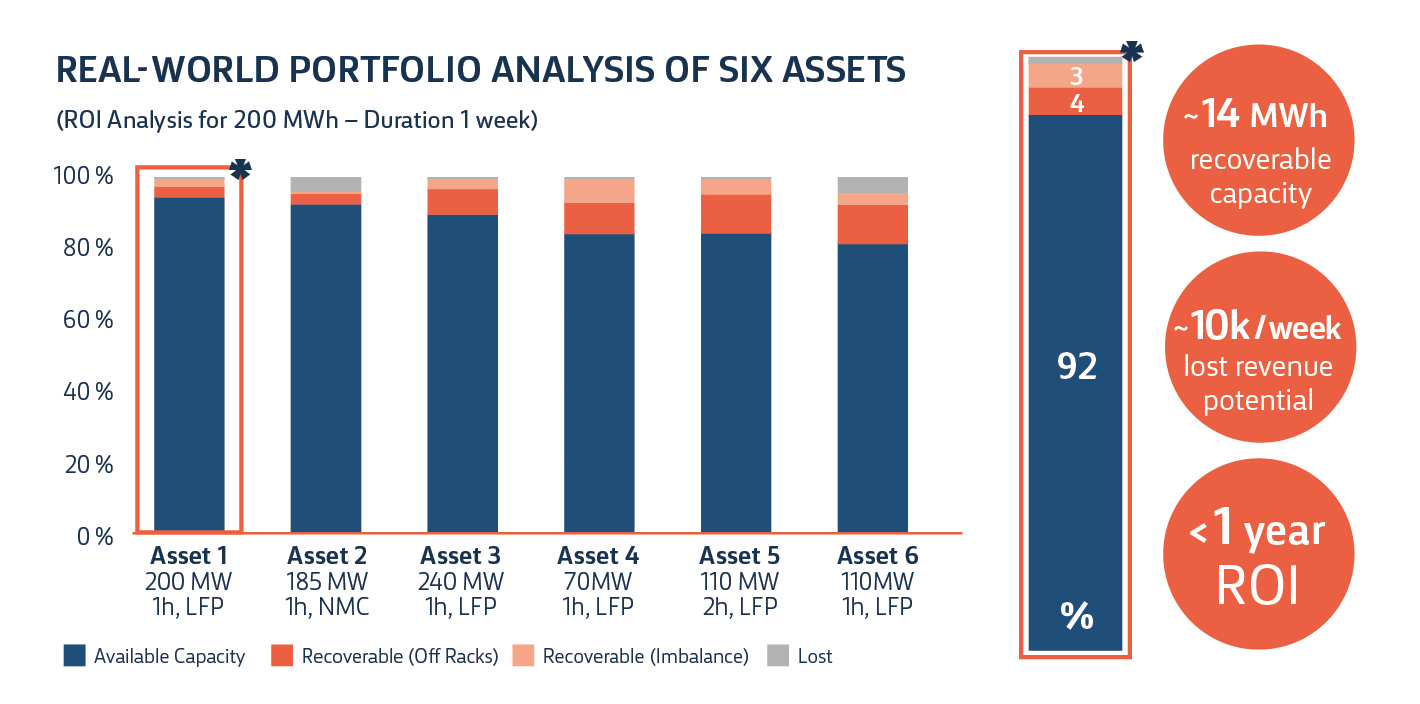
One week of analytics. One 200 MWh LFP asset.
AvEn detected:
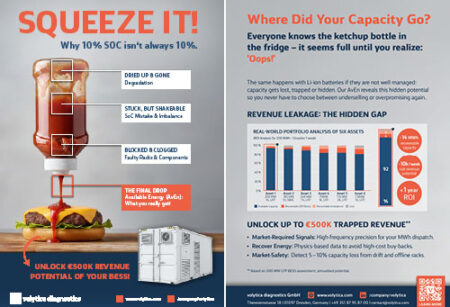
~14 MWh of stranded capacity identified
~€10,000/week in lost revenue potential
>€500,000 annualized lost potential
<1 year ROI on analytics investment
Conservative scenario at €100/MW per 1h.
Market rates vary by region and trading strategy (FCR/arbitrage): below €100 to above €500/MW.
Continuous Multi-layer Battery Analytics. Distilled into Actionable KPIs.
vdx AvEn continuously processes voltage, current, and temperature data across every rack and module, determining SoC (State of Charge) independently from BMS, subunit imbalances, component performance, and OCV (Open-Circuit Voltage) curve characteristics at high frequency.

AvEn — Available Energy
Ready to Trade
For trading and dispatch
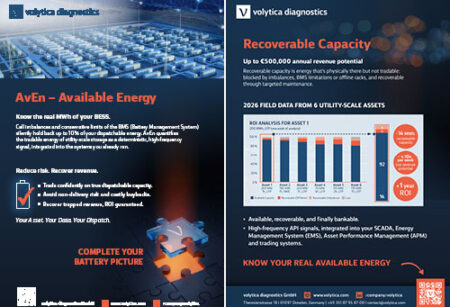
Independent, high-frequency estimation of available chargeable and dischargeable energy, at configurable power scenarios.
- Dedicated API endpoint for EMS and trading platform integration
- Bid on true dispatchable capacity, not on the BMS estimate
- Reduce safety buffers without increasing non-delivery risk

ReCa — Recoverable Capacity
One Signal Away
For O&M planning
Quantification of energy trapped due to imbalances, BMS errors, or offline racks, with guidance on where to act first to recover usefulness.
- Prioritize maintenance by revenue impact, not by alarm volume
- ~14 MWh recoverable on a 200 MWh LFP asset, representing ~€10,000/week at conservative arbitrage rates
Both KPIs can be fully integrated into the volytica dashboard or seamlessly delivered into your existing systems via API, turning analytics into actionable recommendations.
How it Works:
Independent Battery Diagnostics. No Additional Hardware.
vdx AvEn is part of volytica's battery analytics platform, connecting via API to your data sources. No additional sensors, no site visits, no downtime required.
- Physics-based models calibrated to your asset configuration
- Configurable update frequency, from daily assessments to high frequency signals for trading integration
- After a short calibration phase, the system is live
- Compatible with all major BESS configurations and battery chemistries
- Integrates with EMS, SCADA, APM systems and trading platforms
FAQ about Available Battery Energy
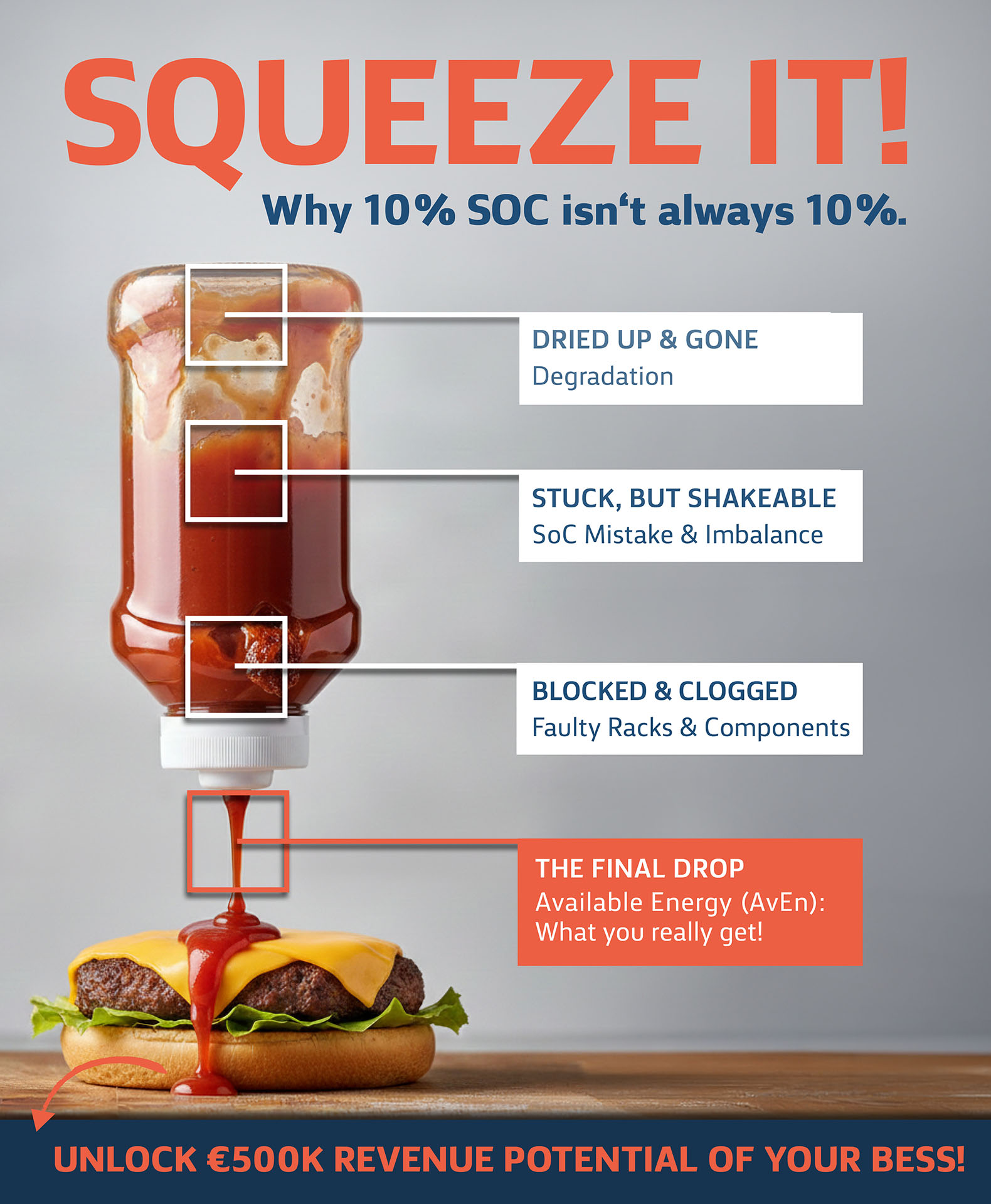
Available energy is the amount of energy a BESS (Battery Energy Storage System) can actually charge or discharge under a given operating scenario, accounting for the real state of all system components. It differs from rated or installed capacity, which reflects the theoretical maximum capacity, and from state of charge, which is a BMS (Battery Management System) estimate that does not account for imbalances, usage scenarios or component limitations.
State of charge is a system-level percentage reported by the BMS (Battery Management System). Available energy is an absolute quantity, in MWh, calculated independently from the bottom up, rack by rack, accounting for subunit imbalances, offline racks, and chemistry-specific OCV (Open Circuit Voltage) curve characteristics.
Non-delivery penalties can cost four times more than the revenue from successful delivery. vdx AvEn provides a high-frequency, physics-based signal that accurately reflects true dispatchable capacity, enabling confident bidding and avoiding penalties.
The opposite case is underpromising: not promising what you are capable of because you are not aware of your own deliverable potential.
Rack-level imbalances, SoC (State of Charge) drift, offline racks, and BMS estimation errors, particularly in LFP (Lithium Iron Phosphate) systems where the flat OCV curve provides limited signal in the mid-SoC range. In large multi-rack systems, these effects compound and are invisible at system level without independent diagnostics.
LFP's flat discharge curve provides very little voltage signal for the BMS in the mid-SoC range, making estimates less reliable for precise dispatch. Stranded capacity and SoC drift are predominantly LFP phenomena, as confirmed by volytica's field data across multiple utility-scale portfolios.
Yes. vdx AvEn is designed for all major battery chemistries, including LFP and NMC. The available energy gap is most significant in LFP systems. For NMC (Nickel, Manganese, and Cobalt) and other chemistries, the same independent assessment applies, with typically smaller but still operationally relevant deltas.
It applies physics-based models to voltage, current, and temperature data from your data sources, reassesses SoC (State of Charge) independently of the BMS (Battery Management System), maps rack-level imbalances, and calculates available chargeable and dischargeable energy at configurable power scenarios.
No. vdx AvEn connects to your existing data infrastructure via API (Application Programming Interface), with no additional sensors, no on-site installation, and no downtime. Onboarding is fully remote and completed after a short calibration phase.
Yes. vdx AvEn provides a dedicated API endpoint for integration into EMS, SCADA, APM systems and trading platforms.

Head of Business Development
Assess the True Dispatchable Energy of Your BESS Portfolio.
Explore our tailored support and learn how to maximize your assets' value.
Don't miss our latest news on company updates, events and products.