How a forensic health audit in 2023 established the proof of concept for a global portfolio monitoring strategy.
March 24, 2026 // Blog // EN
BESS Lifetime Extension: A 90 MWh Diagnostic Deep-Dive
Identifying “Silent” Risks in Grid-Scale BESS Operations
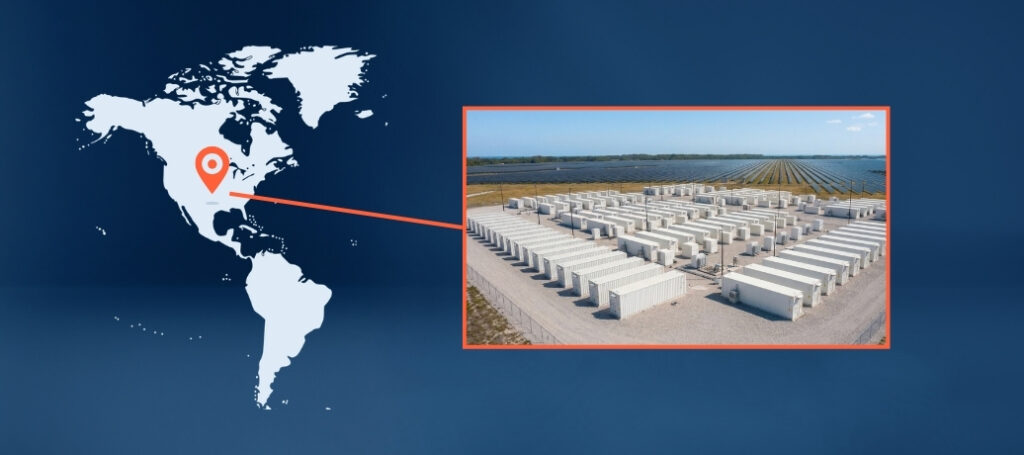
Achieving BESS Lifetime Extension in high-ambient temperatures requires more than standard SCADA monitoring; it requires forensic-level transparency. Operating a 90 MWh grid-scale Battery Energy Storage System (BESS) in high-ambient temperatures presents a significant operational risk: silent degradation.
While standard SCADA systems monitor system-level health, they often fail to detect internal cell-level stress until a safety event or a significant capacity drop occurs.
Seeking to move beyond reactive maintenance, a global power utility initiated a forensic audit of three months of historical field data. The objective was to determine if advanced battery analytics could identify “hidden” anomalies and quantify the ROI of a continuous monitoring strategy.
Technical Findings: Thermal and Capacity Asymmetries using SOBC and SOBT.
The audit utilized high-resolution diagnostics, specifically focusing on two proprietary KPIs to identify deviations within the 24-container fleet:
SOBC (State of Balance Charge)
- Definition: A proprietary volytica KPI that quantifies charge distribution across cells to detect early-stage imbalances.
- Diagnostic Value: Serves as a critical indicator for rack imbalances or potential cell failures that are typically invisible to standard SCADA monitoring.
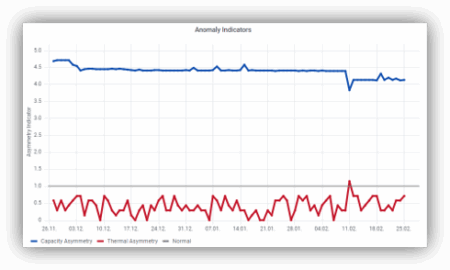
The Finding: The 90 MWh audit identified a capacity asymmetry exceeding 8% between containers. This revealed disbalanced racks and voltage threshold violations that were not being flagged by the SCADA.
SOBT (State of Balance Temperature)
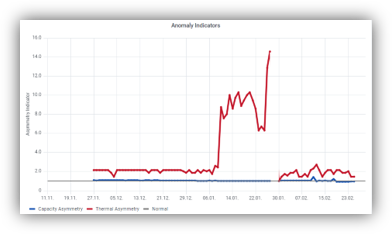
- Definition: A proprietary volytica KPI that quantifies how uniformly temperature is distributed across cells within a system.
- Diagnostic Value: Serves as a critical early-warning system for cooling inefficiencies, operational “hotspots,” or early-stage hardware failures that lead to accelerated aging.
The Finding: The analysis revealed thermal deviations exceeding 10K in isolated racks. These localized temperature spikes were invisible to the SCADA system but were actively driving non-linear degradation. By identifying these “silent” hotspots, the operator could initiate targeted maintenance on the cooling units rather than resorting to costly, plant-wide power derating.
The Diagnostic Truth: Bridging the Gap between Data and Operations
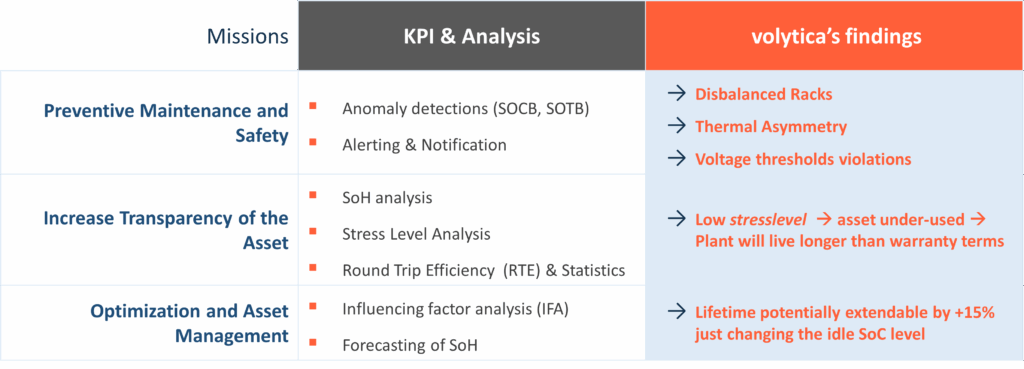
To move from raw data to a strategic O&M roadmap, the forensic audit categorized findings into three actionable pillars: Safety, Transparency, and Asset Management. By applying high-resolution KPIs to historical datasets, the analysis identified critical anomalies that typical SCADA monitoring overlooks. This systematic approach allows operators to shift from broad maintenance schedules to targeted, data-driven interventions and BESS lifetime extension.
- Invisible Thermal Stress: The audit identified temperature deviations exceeding 10K in isolated racks. These thermal asymmetries are early indicators of cooling inefficiencies that lead to accelerated, non-linear degradation.
- Capacity Imbalances: A >8% capacity asymmetry was detected between containers, signaling disbalanced racks and specific voltage threshold violations that required maintenance intervention.
- The Stress Level Paradox: While the asset appeared under-utilized in some areas, the data showed it was being over-stressed during idle phases, a key finding for long-term asset management.
Reducing BESS O&M Costs through Forensic Data Analysis
The primary goal of the project was to translate technical data into economic evidence. The forensic audit proved that transparency directly correlates with cost reduction. By identifying anomalies in less than a week, the client could move from reactive “firefighting” to targeted, preventive maintenance.
The results suggested a potential 30% reduction in O&M costs. By eliminating the need for unnecessary manual performance tests and reducing the Mean Time to Recovery (MTTR) through precise alerting, the diagnostic layer ensures that maintenance resources are only deployed where they are actually needed.
Unlocking BESS Lifetime Extension with Optimized SoC Parameters
The most significant outcome of the deep-dive was the Influencing Factor Analysis (IFA). volytica modeled how the asset’s revenue-generating life could be extended by adjusting its operational profile.
The data demonstrated that by simply optimizing the Idle State of Charge (SoC)—specifically limiting it to 80% during long standby phases—cell stress could be reduced by 23.9%.
- Lifetime Extension: +15% (representing an additional 2 to 3 years of operation).
- Annual Value: Estimated at €150,000 per year for a single 90 MWh site (net of solution costs).
- Revenue Protection: A reduction in downtime risk valued at approximately €20,000 per day.
Conclusion: Moving from an Offline Audit to a Proactive Portfolio Strategy
This 90 MWh use case served as more than just a report; it was a strategic validation. It proved that even historical data contains the “Diagnostic Truth” needed to secure an investment. While the audit was a point-in-time analysis, the findings provided the client with a clear roadmap for the future: transitioning to a continuous, portfolio-wide monitoring strategy to ensure long-term safety, maximized ROI and BESS lifetime extension.
As global storage portfolios scale, the ability to transform raw data into a clear roadmap for longevity is what separates high-performing assets from those left to silent degradation.
“We know everything about our plants… because we look in your tool. We like how you work and what you do.”
— Global Head of Operation & Maintenance, Tier-1 Supplier
Further Reading on Battery Technology:
Since battery degradation varies significantly between different cell chemistries, we recommend our collaborative series in Sustainable Bus. Explore the fundamentals of NMC, LFP, and LTO compositions and their individual aging profiles here.
Protecting your most valuable assets starts with data.
Your batteries represent the core value of your storage projects. Our team is here to help you ensure that value remains secure for the long term through precise, actionable insights. Whether you are looking to audit a single site or scale monitoring across a global portfolio, we are ready to support your technical requirements.